Grammar - Japanese From Zero 1
Navigation
Plurals
Using desu to make a simple statement
Making a question using ka
The question word nani
Culture Clip: Using san for Mr., Mrs., etc.
ko so a do patterns
The topic marker wa
The question words dore and docchi
Using what you know to learn more
Dropping the topic of a sentence
The question word dare
1 Grammar ぶんぽう
Plurals
The Japanese language does not have plurals like English does. For example, mimi means “ear” or “ears,” depending on the context of the sentence. Later you will learn that some words have plural forms, but for now remember that most words can be either plural or singular without any modification.
Using desu to make a simple statement
Desu (usually pronounced “des”), depending on the context, can mean: “it is,” “this is,” “they are,” “these are,” “I am,” “you are,” “he is,” “she is” and “we are.” It is always placed at the end of a sentence. Look at these examples to see how desu is used:
[word] + desu
Example Sentences
- It is a pillow. Makura desu.
- I am Tanaka. Tanaka desu.
- She is Ms. Kobayashi. Kobayashi san desu.
- It is soap. Sekken desu.
Making a question using ka
Ka is like the English question mark. To change a statement in Japanese to a question, you just add ka at the end.
[word] + desu ka
Example Sentences
- Is it a pillow? Makura desu ka.
- Are you Tanaka? Tanaka san desu ka.
- Is she Ms. Kobayashi? Kobayashi san desu ka.
- Is it soap? Sekken desu ka.
The question word nani
The question word nani or nan means “what.” The two versions are used differently. Nani can stand alone to simply mean “What?” Nan cannot be used alone. It is always used with other words such as desu, as in the sentence “Nan desu ka” (“What is it?”).
Example Sentences
- Nan desu ka. What is it?
- Nansai desu ka. How old are you?
- Nani iro desu ka. * What color is it?
- Nani ga suki desu ka. * What do you like?
Culture Clip: Using san for Mr., Mrs., etc.
It’s a custom in Japan to add san to the end of someone’s name. San means “Mr.,” “Ms.,” “Mrs.,” and “Miss,” and can be used on first or last names. It’s considered rude not to use san, especially when talking to or about someone you are not close to, or to someone who is older or above you in status. You should never use san when referring to yourself or someone in your own family.
2 Grammar ぶんぽう
ko so a do patterns
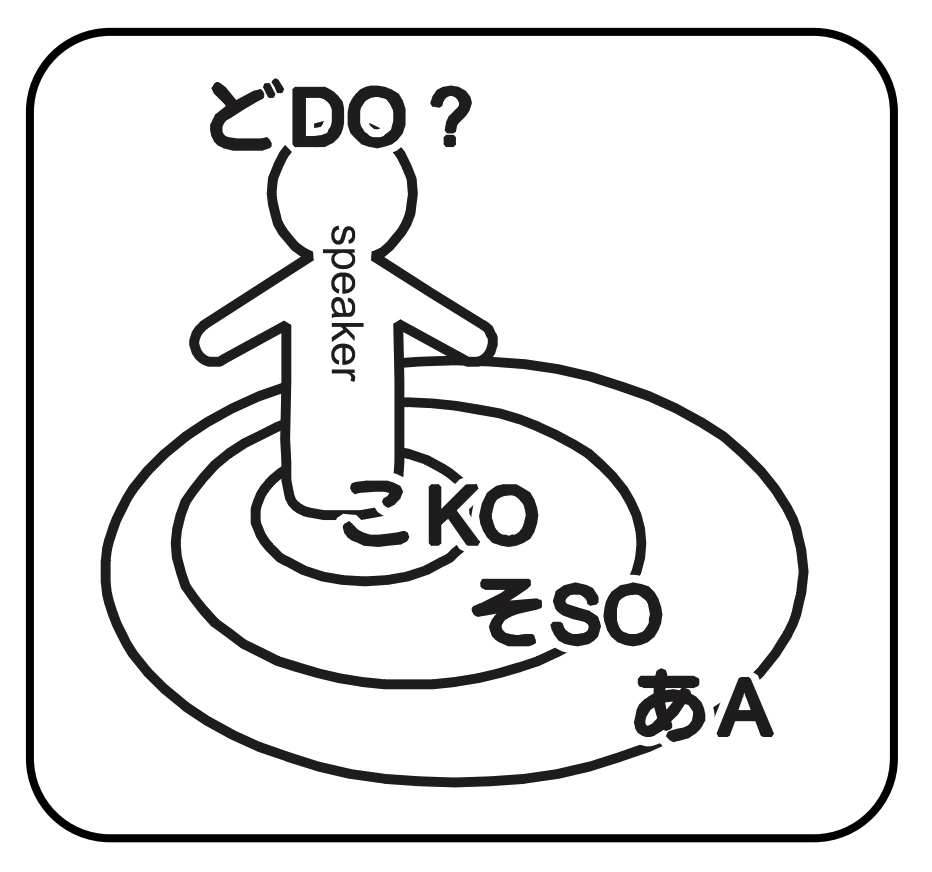
In Japanese, there is a pattern of words that comes up many times. It is the ko so a do pattern. In this lesson there are two ko so a do patterns: kore, sore, are, dore, and kocchi, socchi, acchi, docchi. Notice that each word starts with ko~, so~, a~ or do~. The following chart shows the distance relation of these words to the speaker.
Since the four words in a ko-so-a-do group are similar in sound, they are easy to mix up. The diagram on the right will help you remember the relation of each word in the group to the speaker. Remember this diagram, because there are more ko-so-a-do groups coming up.
- ko – Close enough to touch
- so – Sort of close, but not enough to touch
- a – In the distance. Definitely not close.
- do – Question word.
The topic marker wa
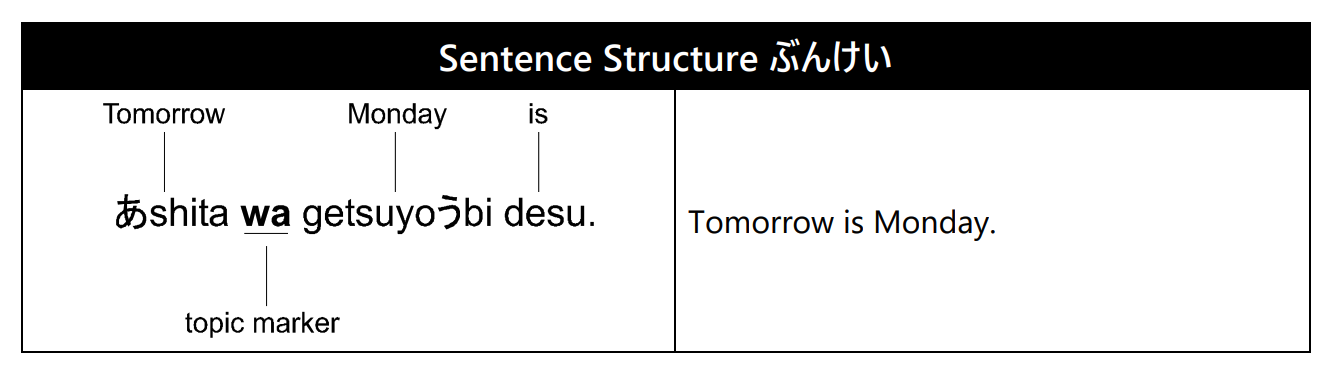
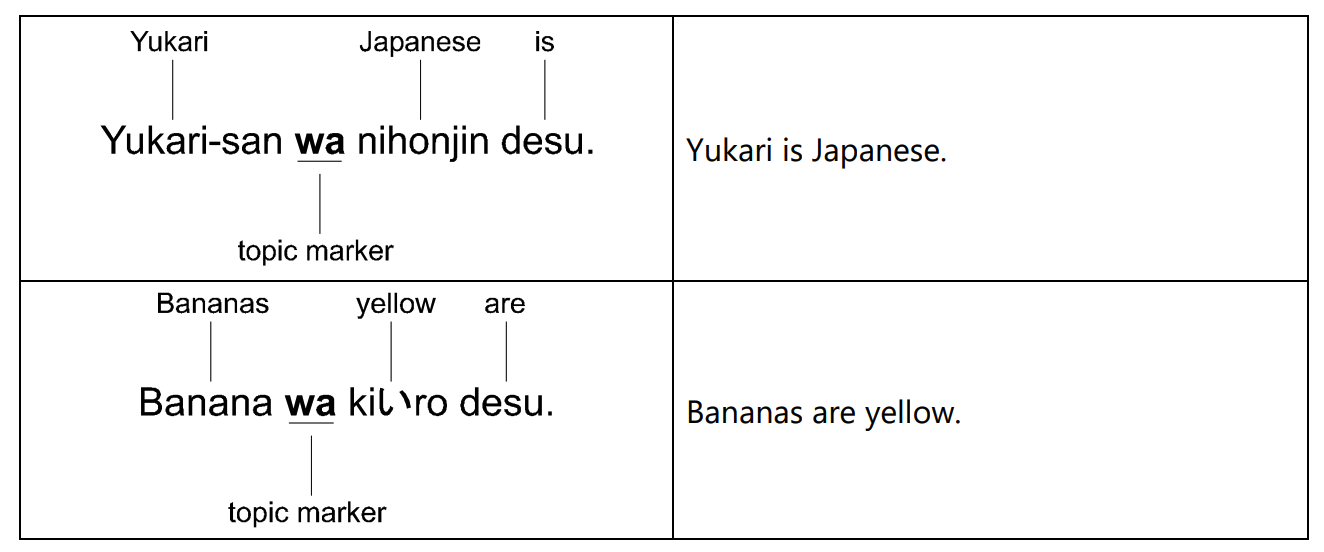
The particle wa is used to mark the topic of the sentence. It can be thought to mean, “Speaking of (the) ~,” or “As for (the) ~,” but it does not have any meaning in English. Generally, everything that comes before wa is the topic or part of the topic. Everything after the wa describes or asks a question about the topic.
[topic] + wa + [question or description]
The question words dore and docchi
Dore and docchi both mean “which one?” Dore is used with groups of three or more. If there are only two items, docchi is used.
[ topic ] + wa dore desu ka
[ topic ] + wa docchi desu ka
Which one is the/a [ topic ]?
If there are three or more items, dore is used.
- Kuruma wa dore desu ka. Which one is the car?
- Furu–tsu wa dore desu ka. Which one is a fruit?
- Yasaい wa dore desu ka. Which one is a vegetable?
If there are only two items, docchi is used.
- Kuruma wa docchi desu ka. Which one is the car?
- Furu–tsu wa docchi desu ka. Which one is a fruit?
- Yasaい wa docchi desu ka. Which one is a vegetable?
Using what you know to learn more
If you don’t know a word, use the Japanese you know to ask someone what the word is. You can use the following sentence to ask what something is. For example, let’s say that you don’t know what えnpitsu means:
Examples
- えnpitsu wa nan desu ka?
What is “enpitsu”? - えnpitsu wa pencil desu.
Enpitsu is a pencil.
3 Grammar ぶんぽう
Dropping the topic of a sentence
It’s very common in Japanese to drop the topic of a conversation once it has been introduced. In English, we constantly restate the topic directly or use “he”, “she”, “they” as a substitute. Spoken Japanese is much more like a match of tennis.
In Japanese, a topic is served and then discussed back and forth. Normally a topic is not mentioned again until a new topic is served.
To illustrate this, look at the following statements about my friend Michiko:
- My friend is Michiko.
- She lives in Japan.
- She is 18 years old.
- She is a college student.
In English, the topic “My friend” is introduced in the first sentence. Then in each following sentence, “she” is used to continually restate the topic. In Japanese, it’s more natural to not say “she” over and over again. Instead, what would be considered incomplete sentences in English are used. This makes for much more natural conversation.
The English equivalent if spoken in Japanese would look like this:
- My friend is Michiko. Watashi no tomodachi wa Michiko san desu.
- Lives in Japan. Nihon ni sundeいmasu.
- Is 18 years old. Juうhassaい desu.
- Is a college student. Daいgakuseい desu.
As you read the example Q&A in the next section, look for places where the topic is NOT repeated.
| Question | Answer 1 | Answer 2 | Answer 3 |
|---|---|---|---|
| 1. Which one is it? (four items) Dore desu ka. |
It is this one. Kore desu. |
It is that one. Sore desu. |
It is that one over there. あre desu. |
| 2. What is this? Kore wa nan desu ka. |
This is a pillow. Kore wa makura desu. |
This is a computer. Kore wa konpyu–ta– desu. |
It’s a blanket. Moうfu desu. |
| 3. Is this a vegetable? Kore wa yasaい desu ka. |
Yes, it’s a vegetable. Haい, yasaい desu. |
No, it’s a fruit. いいえ, furu–tsu desu. |
Yes, it’s lettuce. Haい, retasu desu. |
| 4. Which one is a vegetable? (two items) Yasaい wa docchi desu ka. |
This one is. Kocchi desu. |
That one is. Socchi desu. |
I don’t know. Wakarimasen. |
| 5. What is that? Sore wa nan desu ka. |
That is soap. Sore wa sekken desu. |
This is a towel. Kore wa taoru desu. |
It’s a futon. Futon desu. |
The question word dare
You can use the question word dare just as nan, dore and docchi are used.
| Question (Japanese) | Question (English) | Answer (Japanese) | Answer (English) |
|---|---|---|---|
| Nan desuか。 | What is it? | くruma desu. | It is a car. |
| Dore desuか。 | Which one is it? | Sore desu. | It is that one. |
| Dare desuか。 | Who is it? | Tanaかsan desu. | It is Mr. Tanaka. |
Using wa with dare
As we learned in lesson 2, you can specify a topic using the topic marker wa. Look at how the new question word dare (who) is used.
| Question (Japanese) | Question (English) | Answer (Japanese) | Answer (English) |
|---|---|---|---|
| あnata wa dare desuか。 | Who are you? | Watashi wa こbayashi desu. | I am Kobayashi. |
| かre wa dare desuか。 | Who is he? | かre wa tomodachi desu. | He is a friend. |
| Senseい wa dare desuか。 | Who is the teacher? | Yamada san desu. | It’s Yamada san. |
| Tanaかsan wa dare desuか。 | Who is Tanaka san? | Nihonご no senseい desu. | (She’s / He’s) a Japanese teacher. |